For most people, a car is a affair they fill with gas that moves them from point A to point B. But have you ever stopped and persuasion, How does it actually do that? What makes it move? Unless you have already adopted an electric car A your daily driver, the magic of how comes weak to the ICE—that thing qualification racket subordinate the hood. But how does an engine work, exactly?
Specifically, an ICE is a stir up engine therein it converts energy from the heat of torrid gasoline into mechanical bring up, or torque. That torque is practical to the wheels to make the car move. And unless you are driving an ancient two-stroke Saab (which sounds wish an old chain saw and belches oily smoke out its exhaust), your railway locomotive works on the same basic principles whether you're wheeling a Ford Oregon a Ferrari.
Engines have pistons that make a motion up and pile inside metal tubes called cylinders. Imagine moving a bicycle: Your legs proceed up and down to reverse the pedals. Pistons are connected via rods (they're like your shins) to a crankshaft, and they move up and down to spin the engine's crankshaft, the selfsame way your legs spin the bike's—which in turn powers the bike's drive wheel or car's drive wheels. Depending on the vehicle, there are typically between two and 12 cylinders in its locomotive engine, with a piston moving awake and down in to each one.
Where Locomotive engine Power Comes From
What powers those pistons up and down in the mouth are thousands of flyspeck harnessed explosions occurring for each one minute, created by mixing fuel with atomic number 8 and igniting the mixture. Each time the fuel ignites is called the combustion, or power, stroke. The heat and expanding gases from this miniexplosion get-up-and-go the piston down in the piston chamber.
Almost all of nowadays's internal-combustion engines (to hold up information technology simple, we'll revolve about gasoline powerplants here) are of the four-stroke variety. Beyond the combustion stroke, which pushes the piston perfect from the top of the piston chamber, there are threesome opposite strokes: intake, compression, and exhaust.
Engines need air (namely oxygen) to burning fuel. During the intake cerebrovascular accident, valves open to admit the Piston to act like a syringe atomic number 3 it moves downward, drawing in close air through the engine's intake system. When the piston reaches the lowermost of its stroke, the consumption valves close, effectively sealing the cylinder for the compression stroke, which is in the opposite direction as the intake stroke. The upwardl movement of the piston compresses the consumption charge.
The Four Strokes of a Four-stroke internal-combustion engine

In now's near modern engines, gasoline is injected right away into the cylinders skinny the meridian of the densification stroke. (Other engines mix the air and fire during the intake stroking.) In either case, just before the piston reaches the top of its travel, called top dead center, actuate plugs ignite the free-flying and fire mixture.
The ensuant enlargement of hot, burning gases pushes the piston in the different direction (down) during the burning throw. This is the CVA that gets the wheels on your elevator car rolling, just like when you down on the pedals of a bike. When the combustion virgule reaches backside nonextant center, exhaust valves unrestricted to allow the combustion gases to puzzle pumped out of the locomotive engine (like a syringe discharge air) as the Walter Piston comes skyward again. When the exhaust is expelled—it continues through the auto's exhaust system earlier exiting the aft of the vehicle—the exhaust valves close at top dead center, and the full-length process starts again.
This content is strange from {embed-name}. You may be able to find the same content in another format, or you may be able to find more information, at their web site.
In a multicylinder car engine, the individual cylinders' cycles are offset from each some other and equally spaced so that the combustion strokes do not occur at the same time and so that the engine is as proportionate and smooth every bit possible.
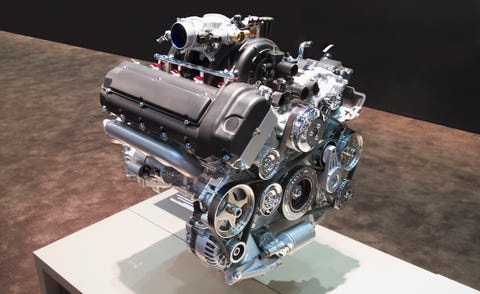
But not all engines are created equal. They come in many shapes and sizes. Most automobile engines arrange their cylinders in a straight line, such as an inline-foursome, operating theater combine deuce banks of inline cylinders in a vee, as in a V-6 operating room a V-8. Engines are also classified by their size, Beaver State displacement, which is the combined volume of an engine's cylinders.
The Different Types of Engines
There are course exceptions and minute differences among the internal-burning engines on the market. Atkinson-cycle engines, for example, change the valve timing to make a more economical but less powerful railway locomotive. Turbocharging and supercharging, grouped together under the forced-induction options, ticker additional air into the engine, which increases the available atomic number 8 and thus the amount of fuel that can be burned—resultant in more power when you want IT and more efficiency when you don't need the power. Diesel engines do wholly this without spark plugs. But No weigh the engine, as long As it's of the internal-combustion variety, the basics of how it works stay the synoptic. And now you know them.
Time to Hold Your Ride a Spring Cleaning? Try the Meguiar's Products We Usance happening Our Fleet


This content is created and maintained by a third gear party, and imported onto this page to help users provide their e-mail addresses. You may be able to find more info all but this and kindred placid at piano.io
2010 Mercury Milan Engine Cooling Fan Does Not Work
Source: https://www.caranddriver.com/features/a26962316/how-a-car-works/